
How LED Lighting and Fabric Quality Affect SEG Light Box Performance
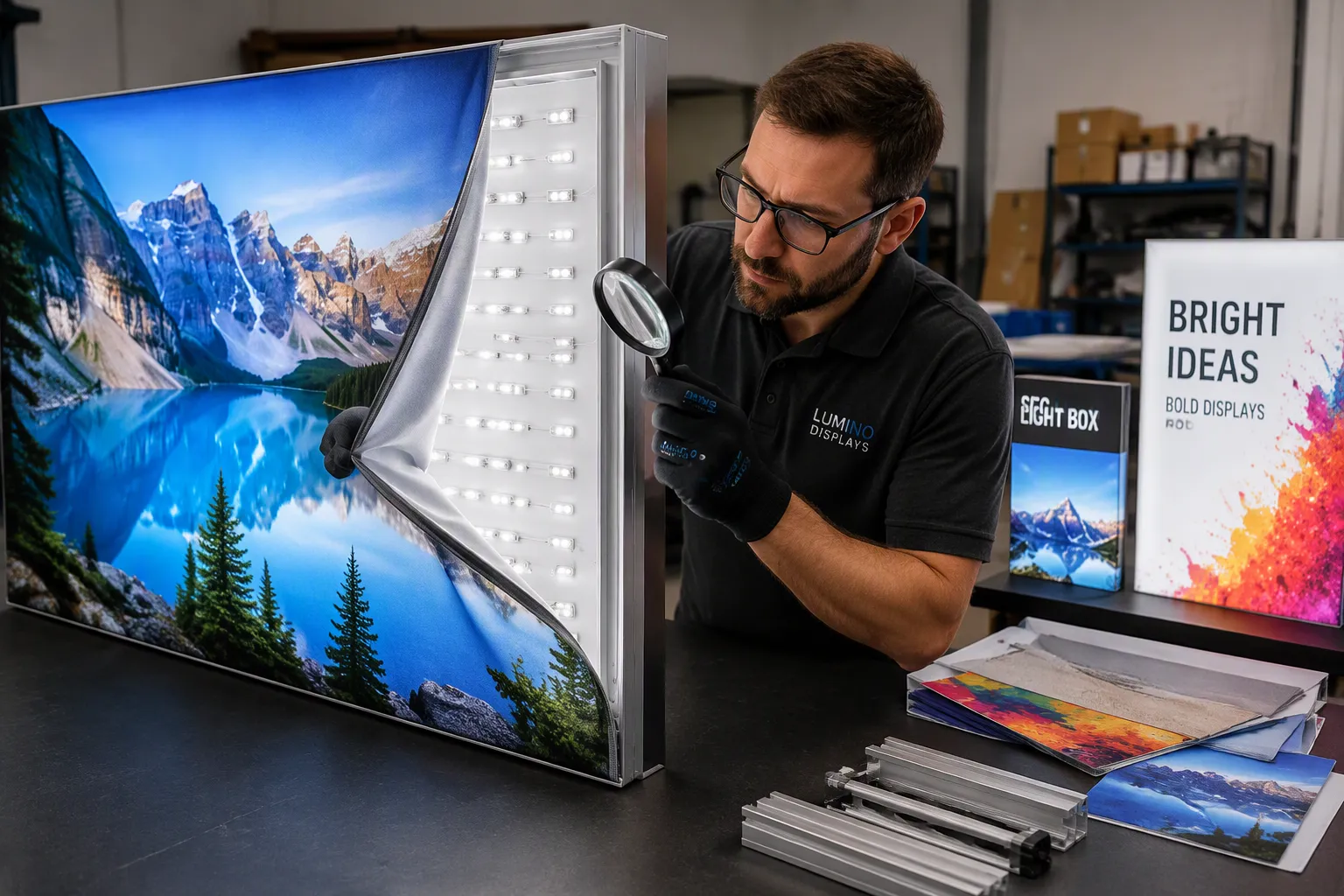
An SEG Light Box performs well only when LED lighting and fabric quality work together. The interplay between these two elements determines whether the final display stays bright, even, and free of shadows. A common problem appears in the field: uneven glow, visible LED hotspots, shadowing through the graphic, or washed-out colors. How do you choose the right LED configuration and fabric to achieve smooth, uniform illumination? Practical decision-making should focus on the combination rather than individual specs. A well-matched pairing of LED layout and backlit fabric matters more than picking the brightest components separately. Each part works with the other. The display delivers clean, consistent light. The right SEG Light Box setup balances light output with fabric diffusion for reliable visual performance.
Key Takeaways
Match LED lighting and fabric quality together for even brightness.
Keep 10-15mm between LEDs and fabric to avoid hotspots.
Choose backlit polyester fabric that fits your frame depth.
Test fabric samples with your actual LED layout before production.
Use dye-sublimation printing for sharp, accurate colors.
LED Lighting Factors That Control SEG Light Box Brightness
LED Spacing, Layout, and Module Distance
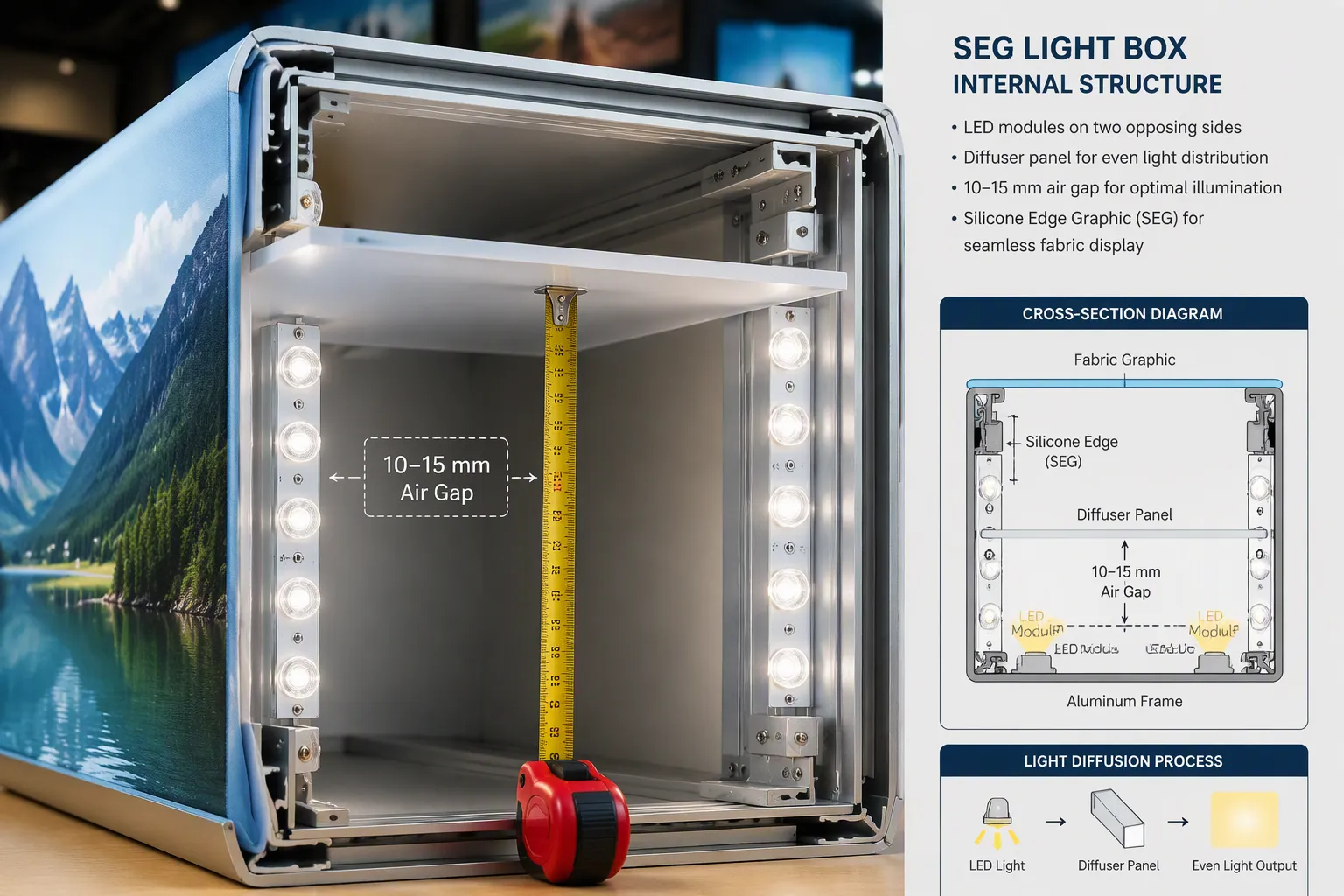
Even illumination in an SEG Light Box depends on three factors: consistent LED spacing, adequate distance between LEDs and the fabric, and balanced power across the entire frame. Increasing LED brightness does not fix shadowing. Higher output often makes hotspots more obvious. LEDs placed too close to the fabric or spaced unevenly will show through regardless of fabric choice.
When LED modules sit too close to the fabric graphic, light lacks sufficient air gap distance to spread and blend before reaching the fabric surface. The illumination remains concentrated directly above each LED, producing bright circular spots with darker regions between them. This effect is known as hotspotting. Reducing cabinet depth minimizes the critical distance needed for even light diffusion. Installation best practices recommend maintaining 10 to 15mm between the LED and the diffuser for optimal uniformity.
Layout strategy matters as much as spacing. In many applications, mounting LEDs on two opposing sides of the frame yields more balanced illumination than lighting all four sides. Lighting all four sides can cause cross-lighting, which concentrates brightness in the corners and creates uneven illumination that fabric alone cannot correct.
Modern LED options address these challenges. Wide beam angles, low heat output, energy efficiency, and edge-lit designs give designers more flexibility. A 170° batwing optic suppresses center-axis light and redirects it outward, letting light cones overlap at shorter distance. This eliminates hotspots in frames as thin as 35mm and needs up to 30% fewer LEDs per square meter. Rigid backlit LED bars use linear aluminum PCBs with integrated lenses in rows, ideal for optical distance of 35 to 50mm. The aluminum base acts as a heat sink, preventing thermal color shifting. Anew Display's SEG light box systems use high-output LED lighting and modular aluminum frames in 40mm, 65mm, 80mm, and 120mm profile widths. These options cover different frame depths and brightness requirements.
Brightness, Color Temperature, and Driver Selection
Raw brightness is not the goal. A target uniformity ratio of 3:1 or better ensures smooth light distribution. A standard 120° lens requires a deep cavity and produces visible hot spots because peak intensity concentrates on-axis. A premium 170° batwing optic works in slim cavities and eliminates this problem.
Color temperature affects how graphics appear. Cool white light suits technical and corporate imagery. Warm white light flatters skin tones and food photography. The driver must match the LED load. An undersized power supply causes flickering or dimming over time. Verify power supply capacity and clean dust from heat sinks to maintain consistent output. Aluminum heat-dissipation channels extend LED lifespan by managing thermal load. For example, retail fashion stores often prefer 4000K-5000K cool white to make fabrics pop, while luxury jewelry stores require high-CRI LEDs to enhance sparkle. Anew Display provides tailored color temperature options to match your specific retail environment.
Fabric Quality Factors That Shape Diffusion and Image Clarity
Backlit Fabric Type, Opacity, and Coating
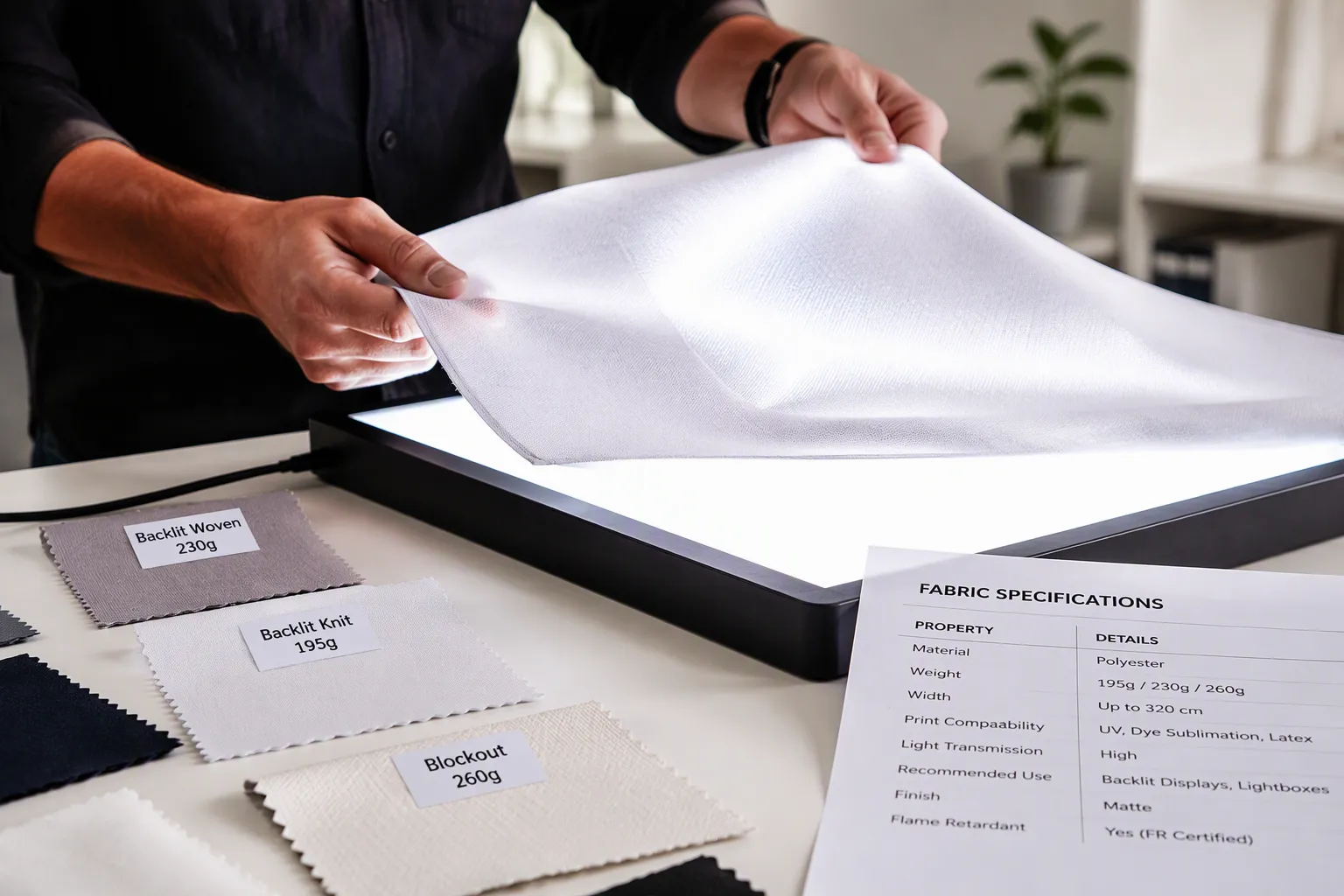
Fabric controls how much light passes through and how accurately colors appear. Opacity must match the frame depth and the LED configuration. A front-lit fabric placed inside a light box will almost always create hotspots. Polyester fabric is the industry standard for SEG graphics because it distributes light evenly and prevents distracting bright spots and shadows.
Knitted fabrics can suffer from "pin hole" or "star" effects, where light escapes through yarn loops. A top coating helps diffuse light, but coating can become marked or bruised. Those flaws show on the graphic once the light box turns on. Woven fabrics offer a tighter structure. VorTex™ Backlit Prism S155 is a bright-white polyester at 4.6 oz/yd². It delivers strong diffusion at low installation depths. VorTex™ Backlit Optimum D270 carries a diffusion layer built to illuminate without pinholes. VorTex™ Backlit Precision T130 uses a transfer coating that resists color distortion at creases.
Fabric | Key Property | Print Compatibility |
|---|---|---|
Prism S155 | 4.6 oz, highly translucent | UV/Latex only |
Optimum D270 | Diffusion layer, no pinholes | Dye-sub direct/transfer, UV, Latex |
Precision T130 | Resists crease distortion | Transfer coated |
Opacity alone is not enough. Stretch matters. Too much stretch distorts fine type and logos. Width and washability matter too. The best method is a physical test. Place a sample over your actual SEG Light Box LED layout before full production. That step reveals how the fabric behaves with your specific frame depth.
Tension, Printing Quality, and Surface Finish
Tension keeps the graphic flat and clean. Silicone edge beading sewn into the fabric edge stretches taut over an edgeless frame, creating a smooth, frameless look. Anew Display's SEG display systems use replaceable silicone edge fabric graphics. This keeps the image flat, clean, and easy to change on site. Dimensional stability matters; the fabric must resist stretching and maintain shape under tension.
Printing quality decides color accuracy. The dye-sub process embeds ink directly into the fibers.
Dye-sublimation bonds the color into the fiber, so the image stays sharp when the fabric folds and flexes.
Request a proof for color accuracy. Check brand colors against a physical reference. Confirm the resolution of every logo and photograph before production. Even ink absorption ensures consistent color across the entire graphic. Uneven dye density or weak diffusion becomes more apparent when light passes through the material.
Surface finish affects how light exits the fabric. A satin finish can soften the glow. A texture adds a tactile dimension to the display. Consistent light diffusion prevents hotspots and shadows. The quality of the print and the quality of the fabric work together. A premium print on the wrong fabric will still look poor. A premium fabric with a weak print will wash out in an SEG Light Box.
The practical rule is simple. Test fabric samples with your actual LED layout before production. Verify the print with a physical proof. Confirm the fabric's opacity, stretch, and coating match your frame depth. These checks prevent expensive reprints. The fabric is not an accessory. It is half of the performance equation.
Matching LED and Fabric for Even SEG Light Box Performance
Aligning LED Output with Fabric Diffusion
Neither LED lighting nor fabric quality alone can guarantee a high-performing SEG Light Box. The two elements must be matched. Backlit SEG textile engineered for LED displays provides controlled diffusion and adequate ink density. Ordinary non-backlit fabric can wash out, show hotspots, or transmit light unevenly. Artwork should be prepared with backlight-specific ink density and color adjustment. A printed color proof should be evaluated with the light box switched on.
Measurable acceptance criteria should be defined before prototyping. These criteria include average luminance after LED warm-up, minimum luminance at corners, joints, and between LED rows, uniformity percentage and its calculation method, color temperature and batch variation, CRI, total power limits, visible hotspots from normal viewing distance, and joint visibility. Prototype testing must use the actual profile depth, LED layout, driver, reflective surfaces, SEG fabric, and print density. A small unprinted diffuser test may not represent the final branded graphic.
Preventing Hotspots, Shadowing, and Brightness Loss
System selection matters. Edge-lit systems can be slimmer but must handle long light-travel distances and edge-to-center brightness loss. Direct-lit systems require sufficient depth for LED beam overlap and are easily expanded with more rows or modules. The correct aluminum profile depth provides adequate light mixing distance, structural stiffness, electrical space, and installation method. Internal support bars must be installed as specified. These bars also control LED positions and prevent visible shadows.
The LED system should be installed and tested before inserting the SEG fabric. Checks cover polarity, voltage, dimming, brightness, and lighting zones. Quality control then includes luminance measurement, lighting-uniformity testing, hotspot, shadow, and joint-visibility inspection, plus color-temperature and CRI inspection. Anew Display supports OEM/ODM customization and applies a 4-step quality gate at specification, assembly, LED testing, and packing inspection. Testing the complete system before deployment prevents costly rework. Properly matched LEDs and premium fabrics not only look better on day one, but they also significantly reduce light decay and fabric yellowing over time, lowering the Total Cost of Ownership (TCO) for long-term brand installations.
Even illumination depends on LED placement and fabric choice together. High-quality LEDs cannot fix an incorrectly chosen fabric. Premium fabric cannot fix a poorly laid-out LED array. Choose LED modules with proper spacing and distance. Match fabric opacity to frame depth. Verify print quality with dye-sublimation. Test fabric samples with your actual LED layout before full production. Work with suppliers who can customize and quality-check the complete SEG Light Box system. This approach prevents hotspots, shadowing, and brightness loss. The result is a display that performs reliably in trade shows, retail spaces, and brand events.
Need Help Choosing the Right LED & Fabric Combination?
Stop guessing and avoid costly reprints. Contact Anew Display’s engineering team today for a free consultation, or request our physical backlit fabric sample kit to test with your own LED layouts.
Get a Free Quote & Sample KitFAQ
These answers address common questions about SEG light box setup and performance.
What is the ideal distance between LEDs and fabric?
Maintain 10 to 15mm between the LED and the diffuser for standard layouts. Insufficient distance creates hotspots. Thin frames need a 170° batwing optic. It eliminates hotspots in frames as thin as 35mm. This approach uses up to 30% fewer LEDs.
Which fabric type works best for SEG light boxes?
Polyester fabric is the industry standard for SEG graphics. It diffuses light evenly. It prevents hotspots. Opacity must match frame depth and LED configuration. Bright-white polyester works well for low installation depths.
Why do hotspots appear with high-brightness LEDs?
Brightness does not fix shadowing. Higher output makes hotspots more obvious. Uneven spacing causes the problem. Insufficient distance also creates visible spots. A wide beam angle spreads light. It overlaps light cones to eliminate hotspots.
What print method preserves color accuracy?
Dye-sublimation embeds ink directly into fabric fibers. Colors remain sharp under backlit lighting. Request a physical proof before production. Verify brand colors with a reference. Uneven dye density appears under backlight.
How can I test an SEG light box before full production?
Test fabric samples with your actual LED layout. Use the real frame depth and print density. Measure uniformity, hotspots, and shadows. Check color temperature after LED warm-up. A small diffuser test cannot represent the final graphic.