
OEM vs ODM: Which Model Fits Your Custom Light Box Business?
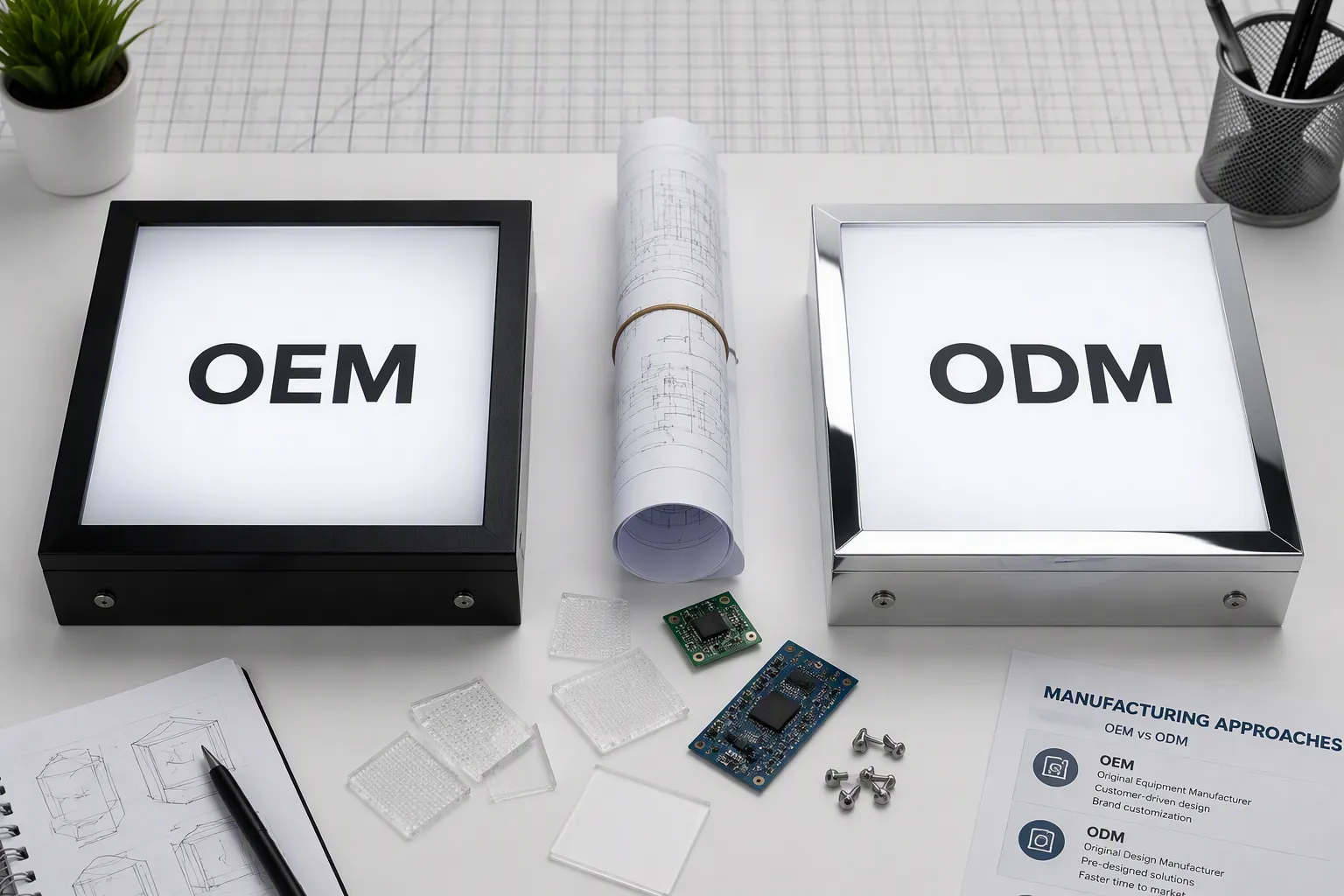
OEM means the buyer provides the design and the manufacturer builds to spec; ODM means the manufacturer owns the design and the buyer customizes it. This distinction shapes every partnership decision for B2B display professionals—such as exhibition equipment wholesalers, digital printing companies, and booth contractors—selecting a custom light box supplier. An original equipment manufacturer builds exactly what the client specifies. An original design manufacturer offers a ready platform for branding and modification. The choice between OEM vs ODM affects control, tooling costs, speed, and market differentiation. This article compares definitions, advantages, disadvantages, costs, and decision scenarios specific to the aluminum extrusion and display industry.
Key Takeaways
OEM means the buyer owns the design. The buyer provides all specifications and funds new extrusion molds.
ODM means the manufacturer owns the design. The buyer customizes existing, proven platforms.
OEM delivers full control and unique private-label products. It requires higher upfront tooling costs and higher MOQs to amortize mold expenses.
ODM offers faster launches, zero tooling fees, and lower MOQs. It limits structural exclusivity.
Choose OEM for strong brand differentiation, proprietary structures, and intellectual property protection.
Choose ODM for quick market entry, bundling with printing services, and leveraging proven modular systems.
Switching from ODM to OEM requires new aluminum extrusion tooling and fresh design work. It costs time and money.
ODM allows extensive customization like size, LED configurations, and fabric choices without opening new molds.
OEM vs ODM at a Glance
Side-by-Side Comparison
The fastest way to understand the difference between these two models is to see them side by side. The table below summarizes the key dimensions that matter most to a growing B2B display business.
Dimension | OEM | ODM |
|---|---|---|
Design ownership | Buyer owns the design & extrusion molds | Manufacturer owns the design & molds |
IP ownership | Buyer retains all IP | Manufacturer retains core structural IP |
Customization level | Fully custom aluminum profiles & structures | Size, lighting, fabric, and finish tweaks on existing profiles |
Lead time | Longer (requires mold creation & DFM testing) | Shorter (platform and tooling already exist) |
Tooling cost | Higher (buyer funds new extrusion dies) | Zero (uses manufacturer's existing mold library) |
MOQ | Higher (to amortize custom mold costs) | Lower (often 1 set for standard platforms) |
Design Ownership and IP
In OEM manufacturing, the buyer develops the design and holds the intellectual property. The factory builds to the buyer's exact specification, often opening new aluminum extrusion dies exclusively for that client. This arrangement gives the buyer full control and market differentiation. In ODM, the manufacturer develops the design and retains the IP. The buyer selects from existing modular platforms and applies branding. The base structural design is non-exclusive, which means the same aluminum profile can be supplied to multiple brands.
Customization and Lead Time
OEM allows complete customization. Every dimension, material, and feature follows the buyer's drawings. This freedom comes with longer lead times because the design must undergo DFM (Design for Manufacturing) evaluation, tooling must be created, and samples must be approved. ODM offers lighter but highly effective customization. Buyers can adjust sizes within the profile's limits, LED configurations, and SEG fabric choices. The platform already exists, so production can begin much faster.
Cost and Minimum Order Quantity
OEM carries higher upfront costs. The buyer funds the aluminum extrusion molds, which can range from $500 to $5,000+ depending on complexity. MOQ requirements tend to be higher for OEM because the factory and buyer need sufficient volume to justify the custom tooling investment. ODM reduces upfront investment to near zero. The manufacturer has already absorbed the mold costs and spreads them across many clients. MOQ requirements are typically much lower, making it ideal for testing new markets.
Quick Takeaway for Decision-Makers
The core difference comes down to who owns the structural design and the tooling. In OEM, the buyer leads and the factory executes. In ODM, the factory provides the proven foundation and the buyer customizes the application. The right choice depends on your differentiation goals, capital availability, and speed-to-market requirements.
What Is OEM in Custom Light Box Manufacturing?
OEM stands for original equipment manufacturer. In this arrangement, the B2B client supplies the design and the factory builds it. The buyer controls every specification of the custom light box. The manufacturer executes the build with precision. This model suits wholesalers and printing companies that want a unique, proprietary product line to dominate their local market.
How the OEM Model Works
The OEM model creates a clear division of labor. The buyer leads the creative and technical direction. The manufacturer focuses on engineering validation, extrusion, and assembly.
Buyer's Role: Design and Branding
The buyer develops the complete product concept. This includes unique frame shapes, proprietary locking mechanisms, or specialized fabric tensioning systems. The buyer also defines the branding elements. This level of control allows wholesalers to build a "Private Label" moat that competitors cannot easily replicate.
Manufacturer's Role: DFM and Build to Spec
The manufacturer receives the buyer's conceptual drawings. A reliable partner like Anew Display doesn't just blindly build; they provide crucial DFM (Design for Manufacturing) support. Their 20-year engineering team evaluates the structural concepts, suggests improvements to ensure the aluminum profiles can be extruded flawlessly, and optimizes the design for cost-effective mass production. This prevents the disaster of opening expensive molds for a design that cannot be assembled.
IP and Customization in OEM
Intellectual property stays with the buyer in an OEM partnership. The design, extrusion dies, and specifications belong to the client. The manufacturer cannot reuse or resell the custom profile to other buyers. This exclusivity protects the buyer's market position and allows for premium pricing.
When OEM Fits a Growing B2B Business
OEM works best for established exhibition equipment wholesalers with clear product vision and capital for tooling. It also suits digital printing companies looking to develop a proprietary frame that perfectly matches the thickness and tension of their specific dye-sublimation fabrics.
This model demands significant investment and patience. The process takes longer than ODM due to mold creation and sampling. However, the resulting exclusive product locks in high-value clients and reduces direct price competition. Anew Display supports OEM manufacturing with strict NDA protocols and dedicated B2B service teams to protect your IP.
What Is ODM Manufacturing in Custom Light Boxes?
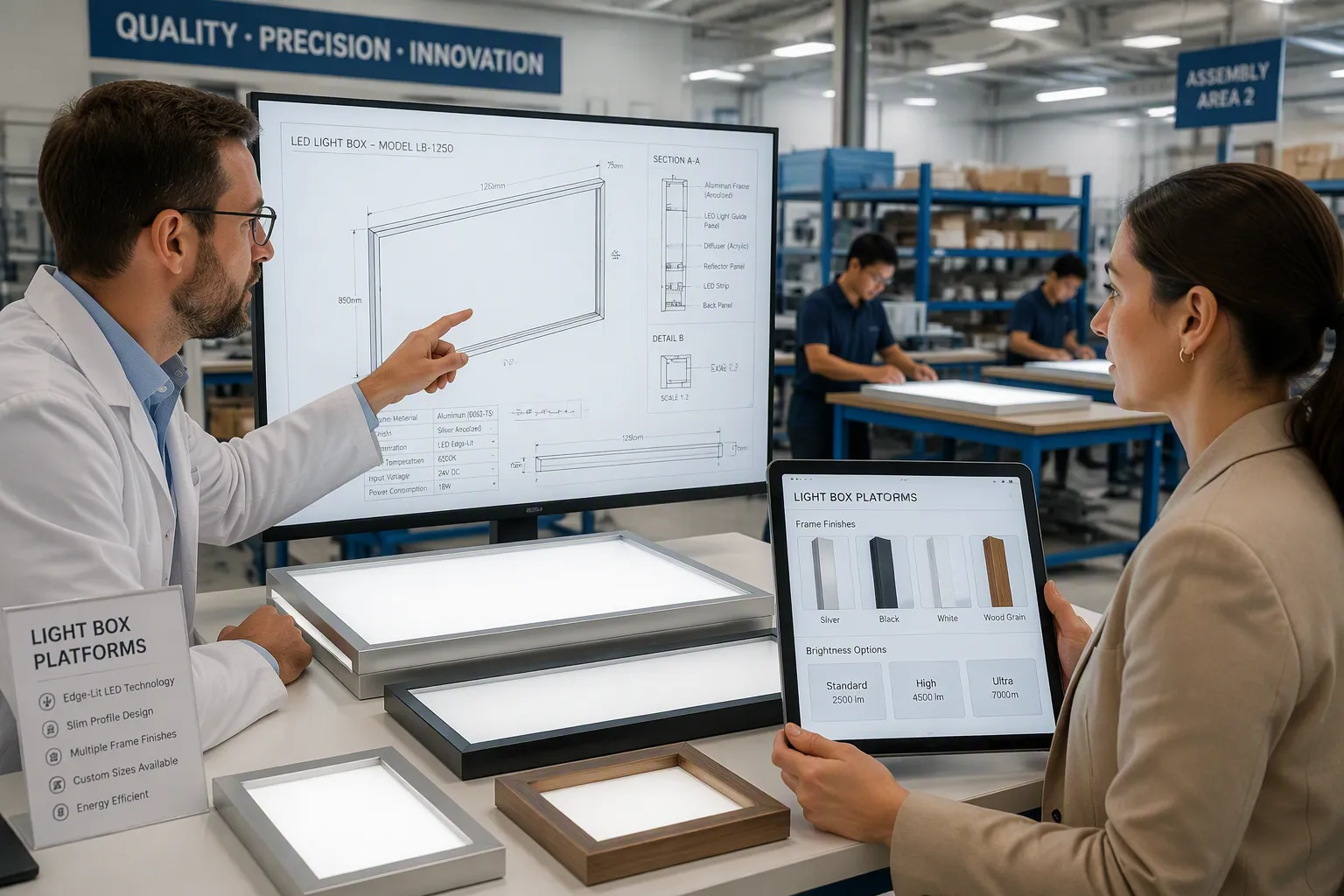
ODM stands for original design manufacturer. In this arrangement, the manufacturer develops and builds the product using existing, validated aluminum extrusion templates. Clients then apply their logos, request specific sizes, or choose custom SEG fabrics. The factory owns the core structural design. This model suits businesses that lack in-house structural engineering resources or want to rapidly expand their product catalog without heavy capital expenditure.
How the ODM Model Works
The ODM model reverses the typical design responsibilities. The manufacturer invests in R&D and maintains a vast library of proven modular systems. The buyer selects from these platforms. A custom light box ordered through ODM manufacturing moves from inquiry to shipment much faster because the factory already holds the tooling, knows the material suppliers, and has perfected the assembly process.
Manufacturer's Role: Platform Ownership
The manufacturer takes full responsibility for structural integrity. Engineering teams have already validated the thermal performance of the LED configurations and the load-bearing capacity of the frames. A manufacturer like Anew Display has years of experience building various platforms like the 8 Way Exhibition System or the 62 Fast Wall. That expertise drastically reduces the risk of on-site failures for buyers who choose ODM.
Buyer's Role: Selection and Modification
The buyer's main task involves selecting the right platform and configuring it. Buyers choose dimensions, frame anodized colors, LED brightness levels, and power configurations. Booth contractors often use ODM to standardize their inventory, allowing their crews to master one modular system that can be configured into dozens of different booth layouts for different clients.
IP and Customization in ODM
Intellectual property for the core aluminum profile stays with the manufacturer. The buyer cannot take the structural design to another factory. For the buyer, this means the base hardware is non-exclusive. However, the application, the fabric graphics, and the final booth configuration remain unique to the buyer's project.
When ODM Fits a Growing B2B Business
ODM manufacturing works best for businesses entering new markets quickly or expanding their catalog. A growing wholesaler that needs to offer SEG light box displays to their retail clients next month cannot wait 8 weeks for OEM extrusion tooling. ODM provides immediate access to proven, reliable hardware with minimal financial risk.
OEM vs ODM vs Contract Manufacturing
Defining Contract Manufacturing
Contract manufacturing is a broad umbrella term describing outsourcing production to an external factory. Unlike OEM or ODM, contract manufacturing does not inherently define who owns the product design. It simply defines who runs the machines and manages the labor.
Key Overlaps and Differences in the Display Industry
Let's look at a real-world exhibition equipment scenario. A European wholesaler might use Contract Manufacturing to have Anew Display assemble their proprietary, self-designed modular frames (this is an OEM nature project). Alternatively, they might select Anew's existing modular tube systems, apply their own brand colors, and sell it locally under their own label (this is an ODM nature project). In both cases, Anew Display acts as the contract manufacturer, but the IP ownership and tooling costs differ vastly.
Advantages and Disadvantages of OEM
Pros of OEM
Higher margins represent the strongest financial advantage of OEM. When a buyer owns the design, no competitor can sell the same light box. This exclusivity allows premium pricing. The buyer captures the full value of the product's uniqueness. Margins on OEM projects often exceed those on ODM orders by a substantial amount.
Full brand control gives the buyer complete authority over every detail. The design specifies dimensions, materials, LED placement, and frame finishes. The buyer's brand appears on a product that exists nowhere else. This control strengthens brand identity.
Stronger client lock-in emerges naturally from exclusive product lines. Once a buyer invests in tooling and engineering, switching factories becomes expensive. The buyer continues with the trusted manufacturer. This relationship stability benefits both parties. Anew Display supports this lock-in through consistent manufacturing quality and responsive service.
Cons of OEM
Higher upfront development and tooling costs create the first barrier. OEM manufacturing demands significant investment before production begins. The buyer funds the entire engineering process and aluminum extrusion dies. These costs can reach several thousand dollars depending on complexity. Not every growing business can absorb this expense.
Longer lead time slows market entry. From specification approval to mold creation, extrusion, and sampling, OEM projects take substantially longer than ODM alternatives.
Heavier engineering and quality control burden falls on the buyer. If the buyer's initial design has structural flaws, the buyer bears the cost of re-cutting the molds. Thorough DFM review with the factory is mandatory to mitigate this risk.
Advantages and Disadvantages of ODM
Pros of ODM
Lower upfront cost represents the strongest advantage of odm manufacturing. Buyers do not pay for tooling or design development. The factory has already invested in those resources. This cost structure makes odm accessible to companies without large capital reserves.
Faster time to market follows from the ready platform. An odm order moves from inquiry quickly. The manufacturing process is already validated. Tooling and assembly procedures exist. A buyer receives products in weeks instead of months.
Proven designs reduce technical risk. The factory has built the same platform for other clients. Any flaws have been addressed. The buyer receives a reliable product. Booth contractors benefit from this reliability, as on-site failures damage their reputation.
Cons of ODM
Lower differentiation creates the primary disadvantage. The same light box platform is available to competing brands. A buyer's product looks similar to others in the market. A brand seeking unique visual identity struggles with odm constraints.
Margin pressure follows commoditization naturally. Buyers compete on price rather than uniqueness. The manufacturing process benefits from volume. The buyer bears the compression.
Cost Comparison: OEM vs ODM for Custom Light Box Projects
Development and Tooling Costs
The OEM path demands heavy spending before the first unit ships. Buyers fund engineering drawings and hard extrusion tooling. Sampling rounds add cost because each revision requires new aluminum profiles. These charges land on the buyer's account.
The ODM path shifts this burden to the factory. The manufacturer already owns the tooling. Buyers pay only for surface changes such as custom Pantone powder coating, specific LED strips, or custom SEG fabric printing. This structure removes the largest barrier for companies with limited capital.
Unit Cost and MOQ
In the aluminum extrusion industry, MOQ and tooling costs are inversely related. OEM manufacturing requires higher MOQs to amortize the expensive custom molds. ODM manufacturing spreads existing mold costs across many buyers. Unit prices remain highly competitive, and MOQ drops significantly—often down to a single set for standard modular light box systems.
Long-Term Profitability
OEM rewards scale and differentiation. Once the tooling is paid off, margins stay strong because the exclusive product blocks direct competition. ODM rewards volume and velocity. Lower setup costs mean faster ROI, allowing businesses to reinvest profits into marketing and sales rather than hardware development.
Choosing Between OEM and ODM
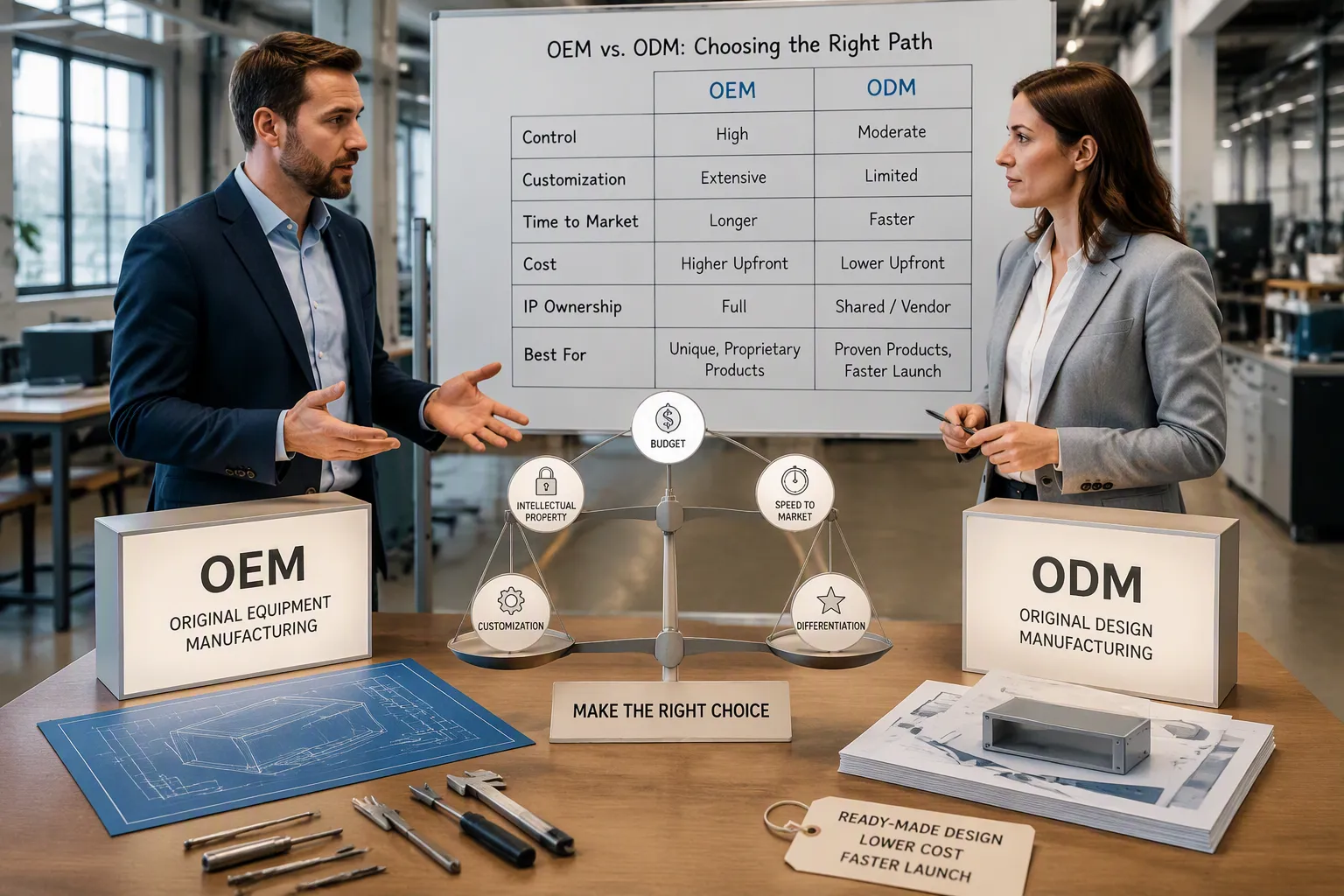
Scenario-Based Guide
Scenario 1: The Wholesaler Seeking a Private Label Moat (Choose OEM)
A regional exhibition equipment wholesaler wants to dominate their market. They invest in OEM to create a proprietary, ultra-slim light box profile that competitors cannot source. The higher upfront mold cost is justified by the long-term premium pricing and exclusive market position.
Scenario 2: The Printing Company Bundling Solutions (Choose ODM)
A digital printing company wants to start selling "hardware + graphics" packages to retail clients. They choose ODM, selecting Anew Display's proven SEG fabric platforms. They avoid mold costs, keep MOQs low, and focus their capital on expanding their printing capacity and sales team.
Scenario 3: The Contractor Standardizing Operations (Choose ODM)
A booth contractor needs a reliable, fast-build system for their crews. They adopt an ODM modular tube system. Because the hardware is standardized and proven, their crew's setup time drops by 40%, drastically increasing their profit margins on labor.
Questions to Ask Before You Commit
Who owns the extrusion molds? This question determines everything about the partnership. In oem manufacturing, the buyer retains all design rights. In odm manufacturing, the manufacturer owns the base platform.
What is the DFM process? Ensure the factory has engineering teams to validate your OEM designs before cutting steel for the molds.
Are the LED components certified? Global markets demand UL, CE, or RoHS compliance. Anew Display provides certified components ready for international distribution.
Common Misconceptions About Custom Light Box OEM and ODM
Myth: OEM Always Costs Less
Many buyers assume the OEM path saves money from the start. This belief confuses unit margin with total investment. The OEM model often demands more upfront capital than ODM manufacturing. Buyers fund product engineering, CAD work, and tooling before production begins. Tooling, molds, and dies alone can cost $500 to $5,000 or more depending on complexity. The ODM model includes these elements in the base factory offering at no additional charge.
Cost Component | OEM Project | ODM Project |
|---|---|---|
Product Engineering & CAD | Buyer responsibility or billed by factory | Included in base factory offering ($0) |
Extrusion Tooling & Dies | $500 – $5,000+ (depending on complexity) | $0 (existing factory tooling utilized) |
Pre-Production Sampling | Higher (multiple iterative structural runs) | Lower (standard pre-production proof) |
Minimum Capital Required | Medium to High | Low to Moderate |
Unit Production Cost | Highly scalable with volume | Highly competitive from low to mid tiers |
The OEM model rewards scale. Unit margins improve as volume grows because tooling costs are already paid. The ODM model delivers competitive unit pricing from low to mid tiers without any initial investment. A growing business must weigh total cost of ownership against per-unit savings. The oem vs odm decision hinges on this calculation.
Myth: ODM Means No Customization
A second misconception holds that ODM manufacturing offers no real design flexibility. This belief is false. The ODM model supports extensive customization options beyond simple logo placement. Buyers can specify custom sizes for any display format. Lighting choices include LED edge-lit or backlit rigid strips and neon options. Face materials range from translucent acrylic panels to dye-sublimated SEG fabric. Cabinet materials include powder-coated aluminum, stainless steel, iron, galvanized sheet, acrylic, and copper. Single or double-sided illumination is available.
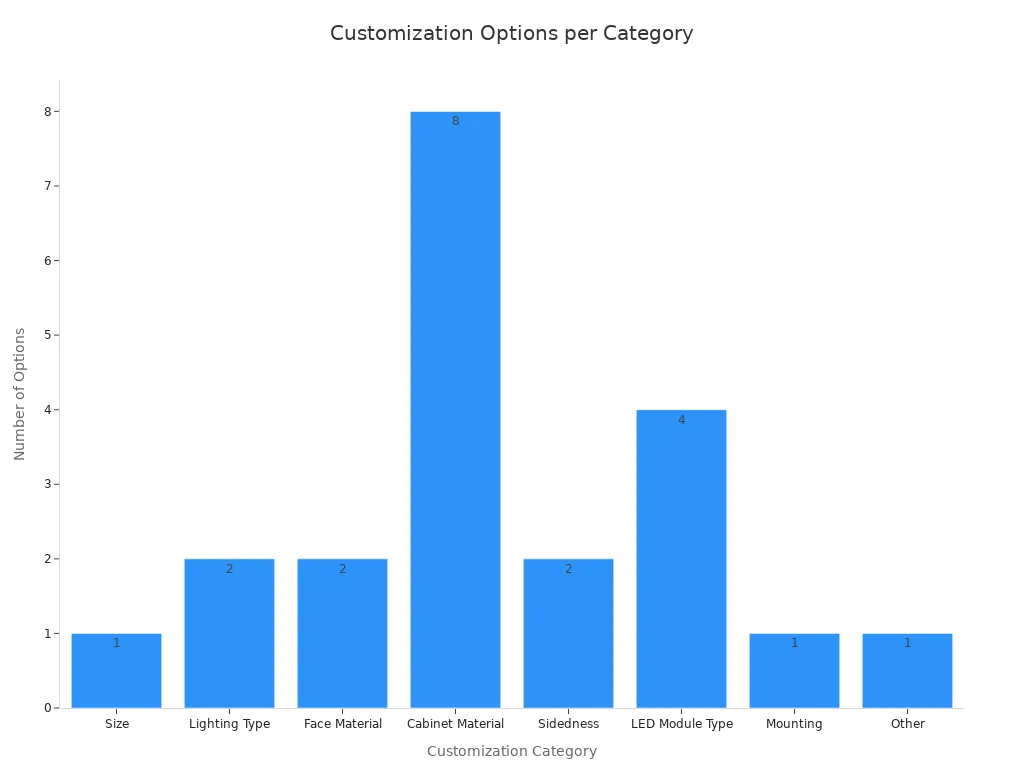
Frame finishes come in silver, black, or custom Pantone colors. Graphic panel materials include PVC film, acrylic panels, or UV-printed fabric. Brightness and color temperature are adjustable and flicker-free. A reliable manufacturer offers these options without requiring new tooling. The buyer applies branding and selects from proven platforms. This level of customization keeps production efficient while meeting diverse client needs.
Myth: Switching Models Is Free
Some buyers believe they can move from ODM to OEM without significant cost. This assumption ignores the structural changes required. Switching from ODM to OEM demands new tooling, fresh design work, and re-certification. The ODM platform belongs to the factory. The buyer cannot take that design to another manufacturer. A transition to OEM requires the buyer to develop original drawings and specifications. New molds and dies must be created. Sampling rounds restart from scratch. Certification testing for CE and RoHS compliance must be repeated for the new design. These steps carry substantial expense and extended timelines.
The core difference is simple. OEM is buyer-led design, where the client owns the extrusion molds and the factory builds to spec. ODM is manufacturer-led design, where the factory owns the proven platform and the buyer customizes the application.
This choice shapes control, cost, speed, and differentiation. OEM delivers full control and unique products at higher upfront cost and longer timelines. ODM offers faster launches and lower investment with shared designs. A growing business should match the model to its strategy, not default to one option. Align the decision with your goals, resources, and market position.
FAQ
What is the main difference between OEM and ODM in display manufacturing?
OEM means the buyer provides the design and funds the custom aluminum extrusion molds. ODM means the manufacturer owns the structural design and existing molds, and the buyer customizes the size, lighting, and branding.
Which model has a lower MOQ?
ODM typically has a much lower MOQ (often 1 set) because it utilizes the factory's existing tooling. OEM requires higher MOQs to justify the upfront cost of creating custom extrusion dies.
Can a printing company use ODM to sell hardware?
Yes. Many digital printing companies use ODM to bundle proven display hardware with their printed SEG fabrics, creating a complete solution for their clients without investing in structural engineering or mold tooling.
What certifications should buyers require from a manufacturer?
CE and RoHS certifications are essential for global markets. Anew Display provides CE and RoHS certified products ready for international distribution. Buyers should confirm certification coverage before committing to any OEM or ODM partnership.
How does Anew Display support both manufacturing models?
Anew Display offers both OEM and ODM capabilities. For OEM, our 20-year engineering team provides DFM support to optimize your custom designs for mass production. For ODM, we offer a vast library of proven modular systems and SEG platforms that can be rapidly customized and shipped globally.
Ready to Start Your Custom Light Box Project?
Whether you need to open custom molds for an exclusive OEM line or want to rapidly deploy proven ODM platforms, Anew Display's engineering team is ready to help. Contact us today for a free DFM assessment or a catalog of our modular systems.
Please Contact Us!
Recent News
1.How to better display the cultural charm of enterprises and brands in the exhibition hall design?
2025-10-142.What are the basic elements of the pavilion design that need attention?
2025-10-143.What are the main points of booth design and construction in exhibition design?
2025-10-144.Why do enterprises have to be exhibition halls when they develop to a certain scale?
2025-10-145.How to highlight the focus of the exhibition?
2025-10-14